

Quick Answer
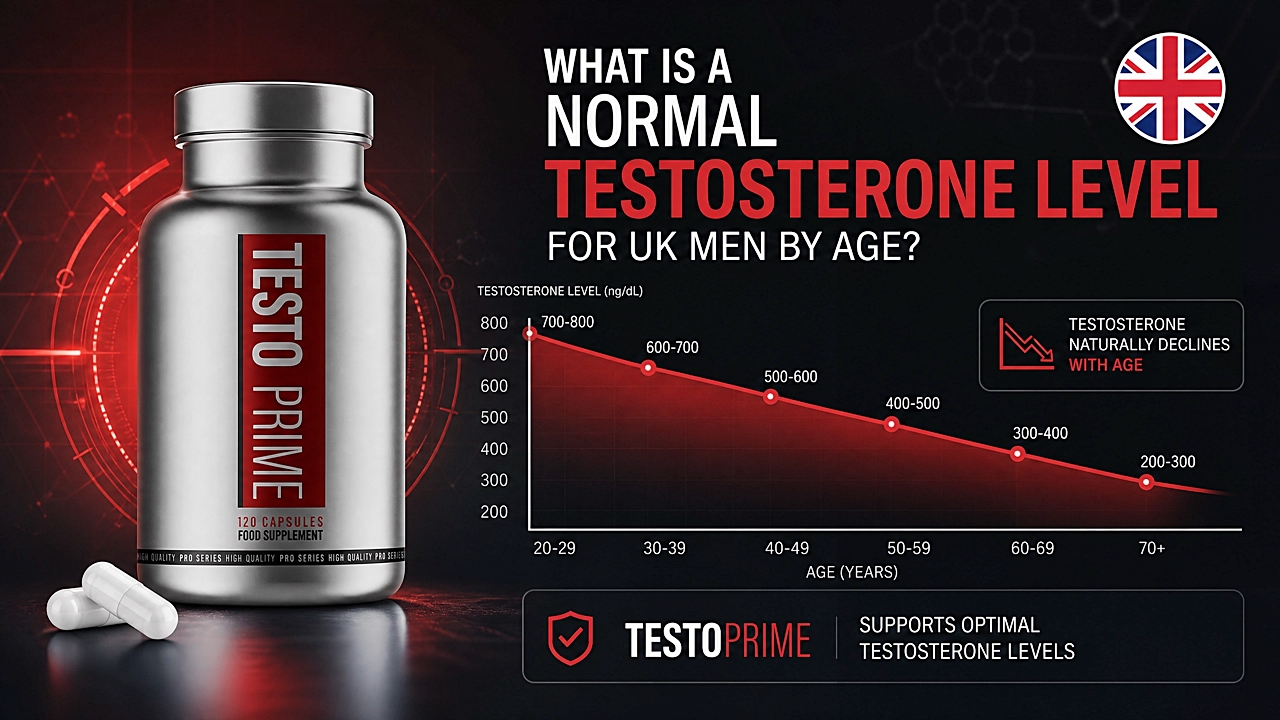
The NHS reference range for total testosterone in adult UK men is 8-30 nmol/L (nanomoles per litre). However, this single range doesn’t reflect age — a 25-year-old at 9 nmol/L is significantly low for his age, while a 65-year-old at 12 nmol/L is roughly average for his.
Typical testosterone levels by age (UK research):
Age Typical total T (nmol/L) 20-29 18-30 30-39 16-26 40-49 14-23 50-59 12-21 60-69 11-19 70+ 9-17 The British Society for Sexual Medicine (BSSM) considers symptomatic men below 12 nmol/L as candidates for treatment, and below 8 nmol/L as clear deficiency.
Why So Many UK Men Get Confused By Testosterone Numbers
If you’ve Googled testosterone levels at all, you’ve probably bumped into a frustrating mess. American sites use ng/dL. UK and European labs use nmol/L. NHS gives you one big range that doesn’t account for age. Private clinics give you different ranges depending on the lab. And nobody seems to agree on what “low” actually means.
This page sorts it out — in UK units, with proper age brackets, using NHS and BSSM reference points, written for British men trying to make sense of their own blood test.
By the end you’ll know exactly:
- What’s normal for your age in the UK
- The difference between total T, free T, and bioavailable T
- Where the NHS and private clinics draw their treatment lines
- Why “normal” and “optimal” aren’t the same thing
- What to do if your number’s lower than it should be
UK vs US Units: The Conversion You Need to Know
Most testosterone content online uses American units. Don’t let that throw you off.
To convert:
- ng/dL × 0.0347 = nmol/L (US to UK)
- nmol/L × 28.85 = ng/dL (UK to US)
So an American man at 500 ng/dL = 17.35 nmol/L in UK terms. A UK man at 14 nmol/L = ~404 ng/dL in US terms. If your blood test came back in ng/dL (some private UK clinics use US units), just multiply by 0.0347 to convert to the range below.
For the rest of this article, everything is in nmol/L — UK standard.
The Full Age Chart: Typical Testosterone Levels for UK Men
These ranges are aggregated from the published research (Travison et al., BMJ Endocrine Reviews, BSSM guidelines, and the European Male Aging Study). They reflect what’s typical — not necessarily what’s optimal or what’s clinically deficient.
Men Aged 20-29
Typical range: 18-30 nmol/L
This is peak testosterone. If you’re in your twenties and your levels are below 15 nmol/L, that’s a clear flag — well below your physiological peak. Lifestyle factors, undiagnosed sleep apnoea, undescended testicles, certain medications, and Klinefelter syndrome are common causes of low T this young.
Men Aged 30-39
Typical range: 16-26 nmol/L
The plateau years. You’re past peak but the decline is still gentle. Below 12 nmol/L at this age with classic symptoms (low libido, fatigue, weight gain, mood drop) is a strong indicator something’s wrong.
Men Aged 40-49
Typical range: 14-23 nmol/L
Decline becomes meaningful. The 1-2% annual drop has compounded for a decade. Many UK men in their 40s sit below their personal optimum even when the lab says “in range.” This is the decade most men first notice low-T symptoms.
Men Aged 50-59
Typical range: 12-21 nmol/L
A significant chunk of UK men in their 50s have crossed below 12 nmol/L. Symptoms become harder to ignore: serious fatigue, soft strength loss, mood and libido changes.
Men Aged 60-69
Typical range: 11-19 nmol/L
Around 20-25% of UK men in this bracket have clinically low testosterone. Many tolerate it for years before testing.
Men Aged 70+
Typical range: 9-17 nmol/L
Decline continues. Symptoms often overlap with general ageing, which is why low T is so under-diagnosed in this age group.
The Critical Caveat the NHS Doesn’t Highlight
Here’s what the NHS reference range (8-30 nmol/L) doesn’t tell you: a 26-year-old at 9 nmol/L is technically “in range” but is severely low for his age. A 68-year-old at 11 nmol/L is “low end” but typical for his age.
The reference range is a population-wide statistical bracket, not an age-adjusted clinical target. Many UK men get told they’re “normal” when their levels are deeply below where they should be for their age — and they’re left feeling rubbish with no explanation.
Always compare your level to your age bracket above, not just the NHS reference range.
Total T, Free T, and Bioavailable T — What Each Means
When you get a private blood panel, you’ll typically see three testosterone numbers. Here’s what they each mean.
Total Testosterone
The full amount of testosterone circulating in your blood. Includes all forms — bound, free, and bioavailable.
- NHS reference range: 8-30 nmol/L
Free Testosterone
The portion not bound to any protein — biologically active, ready to use. This is often more important than total T.
- Typical reference range: 0.20-0.62 nmol/L
- Some private labs report this in pmol/L (1 nmol/L = 1,000 pmol/L)
Bioavailable Testosterone
Free testosterone PLUS the loosely-bound portion that can still be used by your body. Excludes only the testosterone locked up by SHBG (sex hormone binding globulin).
- Typical reference range: 2.5-12 nmol/L
Why This Matters
Two men can have identical total T but feel completely different. Why? Because if one has high SHBG, more of his testosterone is locked up and unusable. His free and bioavailable numbers will be much lower than his total.
This is why men with “normal” total T can still have classic low-T symptoms — and why a proper UK private blood panel always includes free T, bioavailable T, and SHBG, not just total.
NHS vs BSSM: The Two UK Reference Frameworks
NHS
The NHS uses a single adult male total T range of 8-30 nmol/L. Treatment is typically only considered when:
- Total testosterone is below 8 nmol/L on two morning blood tests
- Significant symptoms are present
- Other causes have been ruled out
- A specialist endocrinology referral has been made
The NHS bar is conservative. Plenty of UK men in the 8-12 nmol/L range with significant symptoms get told they’re “in range” and offered no treatment.
BSSM (British Society for Sexual Medicine)
The BSSM publishes more nuanced clinical guidelines used by many UK doctors and private clinics:
| Total T (nmol/L) | BSSM Interpretation |
|---|---|
| Above 12 | Generally adequate |
| 8-12 | “Symptomatic borderline” — treatment may be appropriate with significant symptoms |
| Below 8 | Clear testosterone deficiency — treatment indicated |
The BSSM also recommends checking free T and SHBG, especially when total T falls in the borderline range. This is more aligned with how the rest of European endocrinology operates.
If you’re sitting in the 8-12 range and your GP dismissed you, getting a private specialist opinion under BSSM guidelines is usually worthwhile.
“Normal” vs “Optimal” — They’re Not the Same Thing
This is the most important distinction in this whole article.
A “normal” testosterone level means your number falls within the statistical range of the general male population. An “optimal” testosterone level is where you specifically feel sharpest, strongest, and most yourself.
Plenty of UK men feel rubbish at 11 nmol/L (technically “in range”) and feel transformed at 18 nmol/L. The lab will tell both of them they’re “normal.” Their bodies will tell them otherwise.
This is why pure number-chasing misses the point. The right question isn’t “is my testosterone in the NHS reference range” — it’s “am I at a level where I feel good, perform well, and recover properly?”
If you don’t, and your number’s in the lower half of your age bracket, doing something about it isn’t medically necessary — but it’s often life-changing.
How to Get Your Testosterone Tested in the UK
There are three real options.
Option 1: NHS GP Testing
- Cost: Free
- Wait: Usually 1-3 weeks for appointment + lab turnaround
- What you get: Total T (and sometimes a few others if you push)
- Limitations: Often doesn’t include free T or SHBG. NHS won’t generally test asymptomatic men, so be specific about your symptoms (fatigue, low libido, mood, gym performance).
Option 2: Private Finger-Prick Home Test
- Cost: £40-100 depending on panel
- Wait: 3-7 days for results
- What you get: Full panel (total T, free T, SHBG, sometimes LH/FSH/prolactin/oestradiol)
- UK providers: Medichecks, Numan, Voy, Forth
- How it works: Kit posted to your house, you finger-prick at home (early morning, fasted, between 7-11am), post sample back, results emailed in days
- Best for: Most UK men. Faster, more comprehensive, no GP needed.
Option 3: Private Men’s Health Clinic Consult
- Cost: £150-300 initial consult, plus £80-150 for bloods
- Wait: Days
- What you get: Full panel + medical interpretation + treatment options
- Best for: Men who’ve already done a home test and want clinical follow-up
Important: Time of Day Matters
Testosterone follows a daily rhythm — highest in the morning, lowest in the evening. Always test between 7-11am, fasted. A late afternoon test will give an artificially low result and may lead to incorrect “normal” readings.
If your GP arranged an afternoon blood test, push back and request morning.
What If Your Level Is Below Range for Your Age?
If you’ve tested and your level is below typical for your age — or you’re symptomatic at any level — you have three real paths.
Path 1: Lifestyle First
Properly executed, lifestyle changes can lift testosterone by 15-30% within 3-6 months. This is the right starting point for borderline cases:
- Sleep 7-9 hours
- Strength train 3-4x/week with compound lifts
- Get to a healthier body fat percentage if you’re carrying weight around the middle
- Limit alcohol meaningfully (not “just on weekends”)
- Address chronic stress
- Vitamin D supplementation (most UK men are deficient)
- Eat enough protein and healthy fats
Path 2: Natural Testosterone Booster (+ Lifestyle)
For mild-to-moderate low T (typically 8-14 nmol/L range with symptoms), a clinically-dosed natural testosterone booster can produce noticeable change without medical intervention. The mechanism: ingredients like D-aspartic acid (boosting LH and natural production), ashwagandha (lowering cortisol), fenugreek (blocking aromatase), zinc and vitamin D (supplying production co-factors).
The right product matters enormously. Most off-the-shelf supplements use weak doses. We recommend TestoPrime for UK readers — clinical doses across all 12 ingredients, made by UK-based Wolfson Brands, with a 60-day money-back guarantee.
Path 3: Medical TRT
For clinically deficient men (typically below 8 nmol/L with significant symptoms), medical TRT under endocrinologist supervision is the appropriate route. NHS waits are long (6-12 months); private TRT runs £150-250/month.
TRT is effective but carries trade-offs: it shuts down your natural production, can impact fertility, and is usually a long-term commitment. It’s the right choice for severe deficiency — not for borderline low T where lifestyle and supplementation can do the job.
See our full guide on the difference between TestoPrime and TRT →
A Realistic Goal for UK Men
Forget chasing “optimal” numbers you’ve seen on American podcasts (the “1,000 ng/dL club” nonsense — that’s ~35 nmol/L, well above natural for almost any man).
Realistic targets for UK men by age:
| Age | Sensible target (nmol/L) |
|---|---|
| 30s | 18-22 |
| 40s | 16-20 |
| 50s | 14-18 |
| 60s+ | 13-17 |
Sitting comfortably in these ranges, you’ll feel your physiological best for your age. Push much higher artificially (via TRT) and you start chasing diminishing returns alongside increasing side effects.
The goal isn’t to have the testosterone of a 22-year-old at 45. The goal is to be at the upper end of your age range, feeling sharp, strong, and yourself.
Frequently Asked Questions
What’s a “normal” testosterone level for a 40-year-old UK man?
Typically 14-23 nmol/L based on UK research data. The NHS reference range (8-30 nmol/L) would call anything above 8 “normal,” but for a 40-year-old, a level under 12 with symptoms is genuinely low and worth investigating.
What testosterone level is considered low in the UK?
The BSSM considers below 12 nmol/L with significant symptoms as candidates for treatment, and below 8 nmol/L as clear deficiency. The NHS uses a stricter threshold of 8 nmol/L for treatment consideration.
Why does my NHS blood test say “normal” when I feel awful?
Because the NHS reference range (8-30 nmol/L) is so broad that a man at 9 nmol/L with classic low-T symptoms gets told he’s “in range.” Compare your number to your age bracket (in the chart above), not just the NHS range. Get a private blood panel that includes free T and SHBG for a more complete picture.
Should I test in the morning?
Yes — always. Testosterone peaks in the early morning. A test between 7-11am gives you a usable number. Afternoon tests can read 20-30% lower than morning, giving false “low” readings.
Is it worth testing if I feel fine?
For most men under 35 with no symptoms, no. For men over 40 with any of the 17 common low-T symptoms, yes — earlier intervention is dramatically easier than late intervention.
What’s the difference between total and free testosterone?
Total testosterone is everything circulating in your blood — most of it bound to proteins (mainly SHBG) and unavailable for use. Free testosterone is the small portion not bound, biologically active. You can have “normal” total T with low free T, which still produces low-T symptoms.
Can I raise testosterone without TRT?
Yes — especially for mild-to-moderate low T. Lifestyle changes (sleep, strength training, body composition, alcohol reduction) can lift levels 15-30% over months. A properly-dosed natural testosterone booster like TestoPrime can stack on top of that for further gains.
What level does TestoPrime aim to achieve?
TestoPrime doesn’t have a specific target number — it supports your body’s natural production through clinically-dosed ingredients. Most users report meaningful symptomatic improvement within 8-12 weeks. For UK men in the 9-14 nmol/L range with symptoms, this can be life-changing.
The Bottom Line
A “normal” UK testosterone level depends on three things: your age, what units the lab uses, and which framework (NHS vs BSSM) interprets the result.
For most UK men reading this, the practical answer is:
- Compare your total T to your age bracket above, not just the NHS reference range
- Anything below 12 nmol/L with symptoms is worth investigating, regardless of what your GP says
- Anything below 8 nmol/L is clear deficiency and deserves clinical attention
- “Normal” and “optimal” aren’t the same — being mid-range for your age usually feels meaningfully better than being low-range “in range”
If your number is below where it should be for your age, you have real options — from lifestyle changes to a properly-dosed natural booster to medical TRT, depending on severity.
👉 See the natural testosterone booster we recommend for UK men →
Related Reading
- 17 Signs Your Testosterone Is Low: A UK Man’s Guide — the symptoms post that brings most readers here
- TestoPrime UK review — full breakdown of the natural booster
- Why You Won’t Find TestoPrime in Boots, H&B, or Amazon UK — where to buy safely
Bradley Pugsley
He stumbled into fitness after a back injury at twenty-three left doctors telling him he'd never run again. Refusing to accept this verdict, he built his own recovery program, eventually completing his first marathon at thirty. Now, Bradley transforms complex health science into bite-sized wisdom for everyday athletes. His articles draw from both hard-earned personal experience and conversations with hundreds of fitness professionals across the country.
Similar Posts
17 Signs Your Testosterone Is Low (UK Men’s Guide)
Quick Answer The most common signs of low testosterone in UK men are: persistent fatigue, weight gain around…
Read More
The Relationship Between Low T and Depression
As men, we know that our testosterone is important to us. It plays a huge role in many…
Read MoreDoes smoking lower testosterone?
Over many years now, it has become a widely known fact that smoking is a silent killer. Even…
Read More
10 Tips to Reignite Your Sex Life
Quick Take Long-term relationships naturally settle from the early spark into a steadier rhythm — but that doesn't…
Read More
Does HGH Treatment for Low T-levels Actually Work?
For a long time now, there have been a bunch of ‘treatments’ thrown around for men suffering from…
Read More
Natural Testosterone Boosters: 9 Real Benefits for UK Men (What Actually Changes)
Quick Verdict: What Natural Testosterone Boosters Actually Do A properly-dosed natural testosterone booster supports your body's own testosterone…
Read More