

Quick Answer
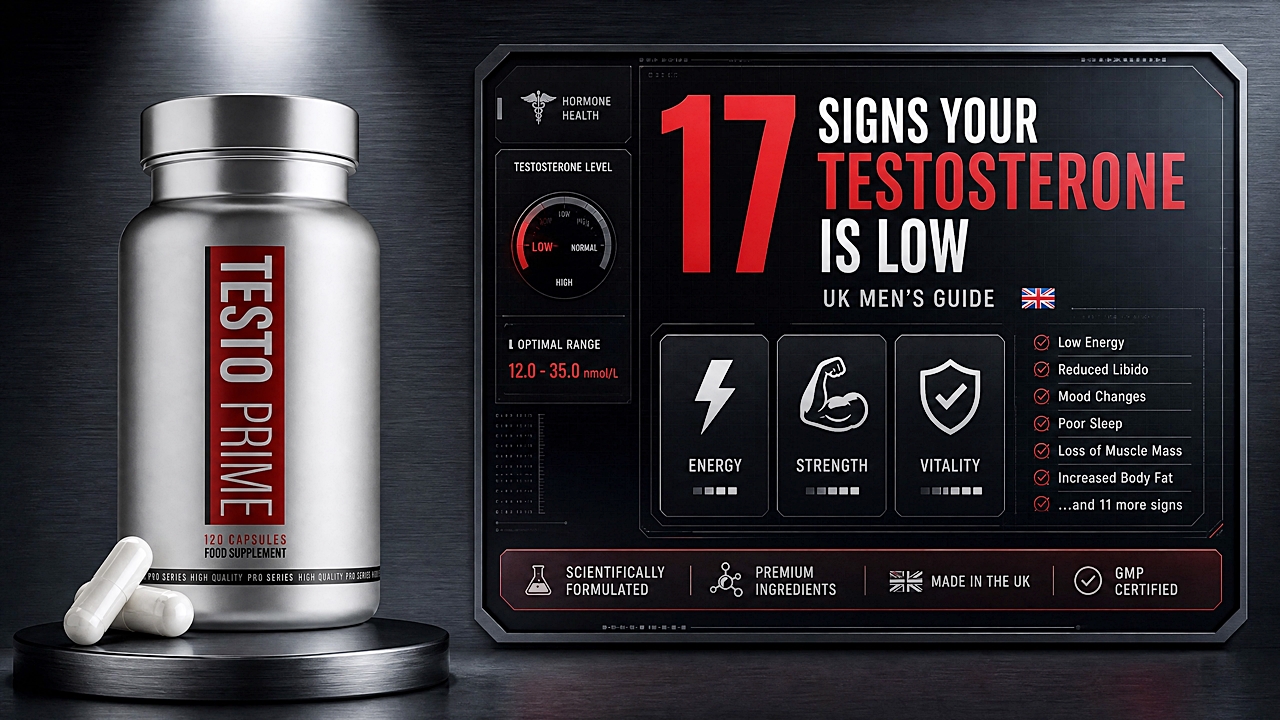
The most common signs of low testosterone in UK men are: persistent fatigue, weight gain around the middle, low libido, weaker erections (especially loss of morning erections), poor sleep, brain fog, mood swings, slow recovery from training, loss of muscle, and a general sense of being “not yourself.” Around 1 in 4 UK men aged 30-79 has low testosterone — and many spend years dismissing the symptoms as just stress or ageing.
“It’s Just Stress.” “It’s My Age.” “I’m Probably Just Tired.”
This is what most UK men tell themselves for years before they finally look up low testosterone symptoms at 11pm on a Tuesday.
If that’s why you’re here, you’re not alone, and you’re not imagining it.
Testosterone is the master male hormone. It does far more than people realize. It shapes your energy, your muscle, your mood, your sleep, your motivation, your drive, your confidence, your fat distribution, your bone density, and your sex life. When it drops, everything drops with it — and the change is gradual enough that most blokes blame work, the kids, the mortgage, or “getting old” long before they consider their hormones.
Here are the 17 signs UK men report most often when they finally test their testosterone — what each one means, and what to do about it.
How Low Testosterone Develops in UK Men (The Quick Version)
Male testosterone peaks in your early twenties, plateaus through your late twenties, then starts a gentle decline from around age 30 — roughly 1-2% per year. By 45, many men are operating on 60-70% of what they had at 25. By 55, it can be 50% or less.
That’s the natural decline. On top of that, modern UK life accelerates it: ultra-processed food, vitamin D deficiency (we don’t get the sun), broken sleep, alcohol, chronic stress from long commutes and desk jobs. The result is that low T in your 30s and 40s — not your 60s — is now extremely common.
A “normal” UK testosterone level on NHS labs is typically 8-30 nmol/L total testosterone. The British Society for Sexual Medicine (BSSM) considers symptomatic men with levels below 12 nmol/L as candidates for treatment, and below 8 nmol/L as clear deficiency.
The catch: many men have classic low-T symptoms even when their bloods come back “in range.” That’s because free testosterone (the bioavailable portion) matters more than total — and total can look fine while free is genuinely low.
The 17 Signs
1. Bone-Deep Fatigue That Doesn’t Lift With Sleep
Not “I’m a bit tired.” We mean the kind of tired where you sleep 8 hours and still wake up feeling like you’ve been hit by a bus. Tasks that used to feel easy take effort. The mid-afternoon energy crash gets worse, and the coffee stops working.
Testosterone is critical for cellular energy production. When it drops, mitochondrial function follows. This is usually the first symptom UK men notice, and the most often dismissed.
2. Belly Fat That Won’t Shift
You’re training the same. You’re eating roughly the same. But there’s a soft middle that’s appearing where there wasn’t one, and conventional dieting isn’t touching it.
This is the testosterone–oestrogen–fat triangle, and it’s vicious. Low T → more fat storage around the middle → more aromatase enzyme in that fat → more conversion of testosterone into oestrogen → even lower T. It self-reinforces.
Aim a fat-loss plan at this, and you’ll fail. You need to break the hormonal cycle first.
3. Loss of Libido (The One Nobody Wants to Mention)
Your sex drive used to be reliable. Now it’s quiet. You’re not actively avoiding intimacy — you’re just not thinking about it the way you used to. The “spark” your wife or partner used to comment on has dimmed.
This is one of the cleanest single indicators of low testosterone. Libido drops aren’t usually about your relationship — they’re about your endocrine system.
4. Morning Erections Have Disappeared
This is the one most men quietly notice but never mention. The morning erection (technically nocturnal penile tumescence) is a marker of vascular health and night-time testosterone activity.
If they’ve gradually faded over months or years, it’s a strong physical signal that hormonal levels have shifted. The BSSM guidelines specifically flag loss of morning erections as a hypogonadism indicator.
5. Weaker, Less Reliable Erections
Different from libido. You may want to, but the body isn’t responding the way it used to. Erections aren’t as firm, take longer to develop, or don’t last.
Testosterone directly affects nitric oxide signalling and vascular function in erectile tissue. Many UK men spend years on PDE5 inhibitors (Viagra, Cialis) when the upstream issue was hormonal all along.
6. Slower Recovery From Workouts
The gym session that used to leave you sore for 24 hours now wrecks you for three days. You used to train four times a week — now you can manage two before you’re shattered.
Testosterone is one of the most important factors in muscle protein synthesis and recovery. When it drops, training capacity drops with it. You’re not getting “old” or “soft” — your body is genuinely working with less.
7. Lost Strength In the Gym
Lifts that felt easy a year ago now feel heavy. Your bench, squat, and deadlift numbers have all slid. You assumed you’d plateau eventually — but this isn’t plateau, this is decline.
Testosterone drives strength gains. Sustained low T causes loss of lean muscle mass and sustained strength decline even with regular training.
8. Brain Fog and Word-Finding Trouble
You walk into a room and forget why. You’re searching for words mid-sentence that should be obvious. Reading something complex requires re-reading. Your sharp edge has dulled.
There are testosterone receptors throughout the brain. Low T directly impacts cognitive sharpness, processing speed, and verbal fluency. Many men describe this as the most disconcerting symptom — it makes you feel like you’re slipping mentally.
9. Mood Crashes / Irritability / Low-Level Depression
You snap at the kids over nothing. You feel flat — not depressed in a textbook sense, just flat. Things that used to genuinely please you don’t really land any more. You’re more cynical than you used to be.
Low testosterone has substantial overlap with depressive symptoms — so much that NHS psychiatrists are now trained to consider testosterone testing in men presenting with low mood. (Reference: published in the BJPsych Bulletin, 2025.)
10. Sleep That Keeps Breaking
You fall asleep fine, but you’re wide awake at 3am and can’t get back over. Or you sleep through but wake unrefreshed. Either way, the deep, restorative sleep you used to take for granted has gone.
Testosterone production peaks during deep sleep. If your sleep is fragmented, T production drops — and if T drops, sleep gets worse. Another vicious cycle.
11. Anxiety You Didn’t Used to Have
A general low-level dread you can’t pin to anything specific. Stress hits harder than it used to. You ruminate at night about things you’d have shrugged off ten years ago.
Testosterone has a regulating effect on cortisol and the stress response. When T drops, cortisol becomes harder to manage — and anxiety quietly creeps in.
12. Reduced Body Hair / Slower Beard Growth
You don’t need to shave as often. The chest or leg hair you had at 30 has thinned. This one develops slowly enough that most men only notice it in retrospect.
Body and facial hair growth is driven by testosterone (specifically DHT, a metabolite of testosterone). Reduced hair distribution is a classic clinical sign of low T.
13. Loss of Confidence and Drive
The general sense that you’re not pushing forward the way you used to. Career ambition is quieter. The competitive edge that drove you in your 30s feels muted. You’re more risk-averse.
Testosterone has a well-documented effect on assertiveness, risk tolerance, and competitive drive. When it drops, the personality changes are real even if they’re subtle.
14. Hot Flushes / Night Sweats
Yes, men get these too. They’re not as commonly discussed as in menopause, but they’re a recognised symptom of significant testosterone deficiency. Waking up sweating with no obvious cause is worth flagging.
15. Gynaecomastia (Mild Breast Tissue Development)
When testosterone drops and oestrogen rises (often via the aromatase-in-fat cycle), some men develop small amounts of breast tissue. Different from chest fat — this is glandular tissue, often tender to touch.
This one is worth seeing a GP about, both for the hormonal cause and to rule out other issues.
16. Bones Feeling Achier / Joint Pain
Testosterone supports bone density and connective tissue. Sustained low T can cause low-level joint achiness and, over years, contribute to osteopenia. If your knees, lower back, or shoulders are achier than they should be for your age, hormones can be part of it.
17. The “I Just Don’t Feel Like Me Any More” Feeling
This is the meta-symptom — the one underlying all the others. You can’t quite put your finger on it. You’re not depressed exactly. You’re not ill. You’re just… not the bloke you used to be.
If you’re reading this and quietly nodding, that’s the signal.
How Many of Those Did You Recognise?
If you ticked off 3 or more, low testosterone is genuinely worth investigating.
If you ticked off 6 or more, the probability is very high.
If you ticked off 10+, you should book a blood test this week.
How to Get Tested in the UK (NHS vs Private)
The NHS Route
- Book a GP appointment. Tell them you’re concerned about low testosterone and describe your symptoms specifically.
- Bloods. They’ll typically order total testosterone + a couple of related markers. The test has to be taken in the morning (testosterone peaks early), ideally between 7am-11am, fasted.
- Two tests. UK guidance requires two separate morning tests on different days to confirm. They may also run free testosterone, LH, FSH, SHBG, and prolactin.
- Referral. If both tests come back low and you have symptoms, your GP can refer to endocrinology. Waiting times currently run 6-12 months in most regions.
- Treatment threshold. NHS thresholds are conservative — typically total T below ~8 nmol/L plus significant symptoms.
The Private Route
- Online finger-prick test (~£60-100). Companies like Voy, Numan, and Medichecks send a home kit. You post bloods to a lab, get results in 3-7 days.
- Private clinic consult (~£150-300). If results indicate low T, you can move to a private men’s health clinic for proper assessment.
- Faster, lower threshold. Private clinics are generally more flexible on treatment cut-offs and waiting times are days, not months.
For most UK men, the smartest move is: get a private home blood test first to confirm whether low T is in play. If it is, then decide whether you want to pursue NHS, private TRT, or natural support.
(More detail in our full NHS vs private testosterone test guide.)
So You’ve Confirmed You’re Low. Now What?
You have three real options:
Option 1: NHS or Private TRT (Testosterone Replacement Therapy)
- Right for: Clinically severe low T (under ~8 nmol/L), or men with significant symptoms and confirmed deficiency
- Pros: Direct, fast, effective
- Cons: Shuts down natural production; fertility impact; potentially lifelong; £150-250/month private or 6-12 month NHS wait
Option 2: Lifestyle Overhaul Alone
- Right for: Borderline low T with clear contributing lifestyle factors
- Pros: Free, no side effects, comprehensive health gains
- Cons: Slow; requires sustained discipline; may not move the needle enough if levels are significantly low
- The protocol: Sleep 7-9 hours; strength train 3-4x/week; eat enough protein and fat; reduce alcohol; get vitamin D; manage stress
Option 3: A Natural Testosterone Booster + Lifestyle
- Right for: Most UK men in the “mildly to moderately low” range, or men who want a noticeable boost without medical intervention
- Pros: No prescription, no shutdown of natural production, no needles, easily stopped if it doesn’t suit you, cumulative with lifestyle work
- Cons: Takes 6-12 weeks for full effect; not adequate alone for severe deficiency
- What we recommend: A clinically-dosed, transparent-label formula — see below.
The Natural Testosterone Booster We Recommend for UK Men
After years of testing different products, the natural booster that consistently delivers for UK men with mild-to-moderate low T is TestoPrime — formulated by Wolfson Brands, a Glasgow-based UK supplement company.
What makes TestoPrime work where most boosters don’t:
- Clinical doses. 2,000 mg D-Aspartic Acid (the research dose, not 200 mg), 668 mg KSM-66 Ashwagandha, 8,000 mg Panax Ginseng — full strength, not pixie-dust.
- Twelve ingredients targeting the five mechanisms that actually move testosterone: production, oestrogen conversion, cortisol, free T, and supporting systems.
- Fully transparent label. Every milligram listed — no “proprietary blends” hiding weak formulation.
- UK-friendly. Free Royal Mail tracked delivery, GBP pricing, 60-day money-back guarantee, dispatched discreetly from UK warehouses.
- No prescription, no needle, no shutdown. Works with your body’s own testosterone production rather than overriding it.
It won’t substitute for medical TRT in severe cases. But for the millions of UK men sitting in the “noticeably affected but not clinically catastrophic” range, it’s the strongest natural option on the market.
👉 See our full TestoPrime UK breakdown →
Frequently Asked Questions
What testosterone level is considered “low” in the UK?
NHS labs typically use a reference range of 8-30 nmol/L for total testosterone. The British Society for Sexual Medicine considers symptomatic men below 12 nmol/L as candidates for treatment, and below 8 nmol/L as clear deficiency.
Can I have low testosterone at 25 or 30?
Yes — increasingly common in the UK. Lifestyle factors (poor sleep, alcohol, ultra-processed food, vitamin D deficiency, stress) can push T levels down well before age-related decline kicks in.
Is “manopause” real?
The term is informal but the phenomenon is real — the medical term is late-onset hypogonadism or testosterone deficiency syndrome. Around 1 in 4 UK men over 30 has clinically low testosterone.
Do testosterone boosters actually work?
The honest answer: most don’t. The ones that do contain clinically-dosed, well-studied ingredients (D-aspartic acid, ashwagandha, zinc, vitamin D, fenugreek) at the levels used in actual research — not the watered-down doses most cheap supplements use.
Will natural testosterone support fix severe low T?
No. If you’re clinically hypogonadal (typically T below 8 nmol/L with significant symptoms), you need medical TRT under specialist care. Natural support is appropriate for mild-to-moderate low T, or as adjunct to a healthier lifestyle.
How long until I’d notice a difference?
With lifestyle changes alone: 8-16 weeks. With a clinically-dosed natural booster like TestoPrime alongside lifestyle work: most men report noticeable changes by week 3-4, with bigger transformation at weeks 8-12.
Can low T affect mental health?
Yes — significantly. Recent NHS-published research has highlighted the overlap between low testosterone and depressive/anxiety symptoms in men. Many men experience real mood improvement when testosterone is restored.
The Bottom Line
If half this article landed too close, you’re almost certainly dealing with declining testosterone — and you’re far from alone. Around 1 in 4 UK men over 30 are in the same boat.
The good news: you can do something about it. Test your levels (NHS or private), look hard at the lifestyle levers (sleep, training, alcohol, stress, food), and consider a properly-dosed natural testosterone booster if your levels are mild-to-moderately low.
You don’t have to accept feeling flat, tired, and faded as your new normal. The version of you that woke up sharp, trained hard, and felt alive — he’s still in there. You just need to give your body what it needs to produce him again.
👉 See the TestoPrime UK breakdown — our recommended natural booster →
Bradley Pugsley
He stumbled into fitness after a back injury at twenty-three left doctors telling him he'd never run again. Refusing to accept this verdict, he built his own recovery program, eventually completing his first marathon at thirty. Now, Bradley transforms complex health science into bite-sized wisdom for everyday athletes. His articles draw from both hard-earned personal experience and conversations with hundreds of fitness professionals across the country.
Similar Posts
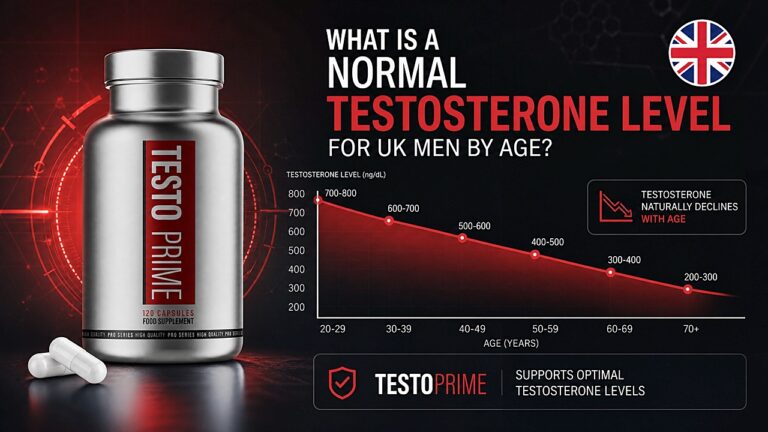
What Is a “Normal” Testosterone Level for UK Men by Age? (Full nmol/L Chart 2026)
Quick Answer The NHS reference range for total testosterone in adult UK men is 8-30 nmol/L (nanomoles per…
Read More
The Relationship Between Low T and Depression
As men, we know that our testosterone is important to us. It plays a huge role in many…
Read MoreDoes smoking lower testosterone?
Over many years now, it has become a widely known fact that smoking is a silent killer. Even…
Read More
10 Tips to Reignite Your Sex Life
Quick Take Long-term relationships naturally settle from the early spark into a steadier rhythm — but that doesn't…
Read More
Does HGH Treatment for Low T-levels Actually Work?
For a long time now, there have been a bunch of ‘treatments’ thrown around for men suffering from…
Read More
Natural Testosterone Boosters: 9 Real Benefits for UK Men (What Actually Changes)
Quick Verdict: What Natural Testosterone Boosters Actually Do A properly-dosed natural testosterone booster supports your body's own testosterone…
Read More